Lab-Grown vs Mined Diamonds for Engagement Rings
Table of Contents
- Lab-Grown and Mined Diamonds: What You’re Actually Choosing
- How Each Diamond Forms: Origin and Timeline
- Lab-Grown Diamond Pros and Cons for Engagement Rings
- Lab-Grown Diamond Price vs Natural Diamond Price
- How to Tell Lab-Grown from Mined Diamonds
- Do Lab-Grown Diamonds Hold Their Value Over Time
- Which Diamond Type Is Right for Your Engagement Ring
- Frequently Asked Questions
Last Updated: October 11, 2026
Lab-Grown and Mined Diamonds: What You’re Actually Choosing
When you’re shopping for an engagement ring, the diamond itself is often the centerpiece of your decision. But here’s what most guides skip: the choice between lab-grown vs mined diamonds for engagement rings isn’t just about sparkle or price. It’s about understanding what you’re actually buying, how it was created, and what that means for your ring’s future.
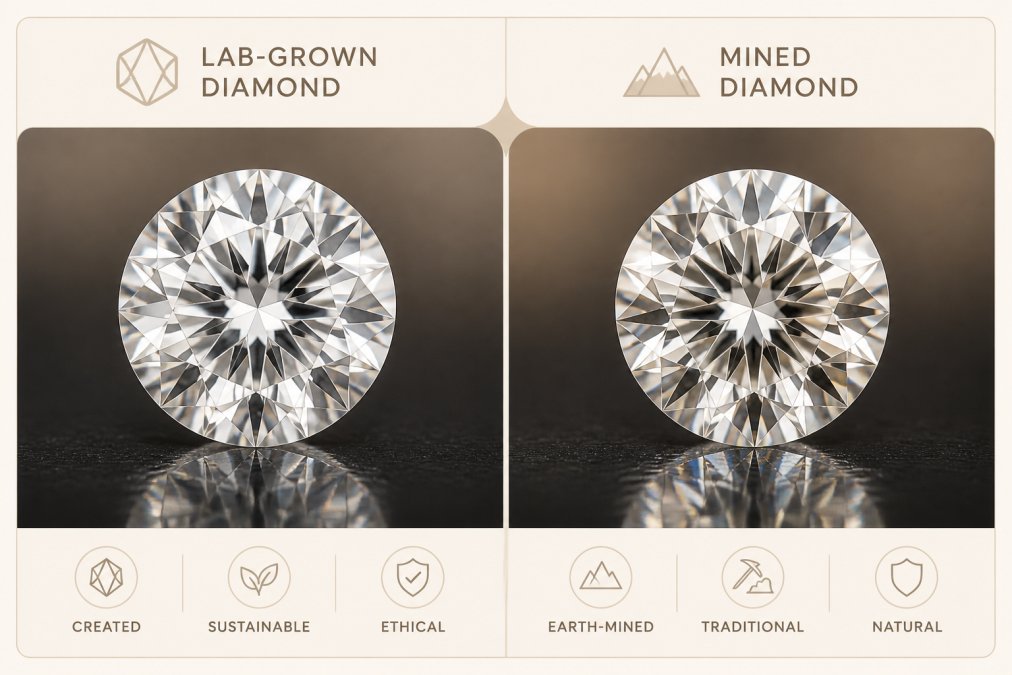
Both lab-grown and mined diamonds are chemically identical. They’re both carbon arranged in the same crystal structure. The difference lies in origin, timeline, and value perception, and those differences matter more than you might think.
At Amoré Lux, we work with couples who care deeply about what their ring represents. Whether you choose lab-grown or mined, the goal is the same: a piece that feels authentic to your values and stands up to everyday wear. Below, we’ll walk you through both options so you can make the choice that’s right for you.
How Each Diamond Forms: Origin and Timeline
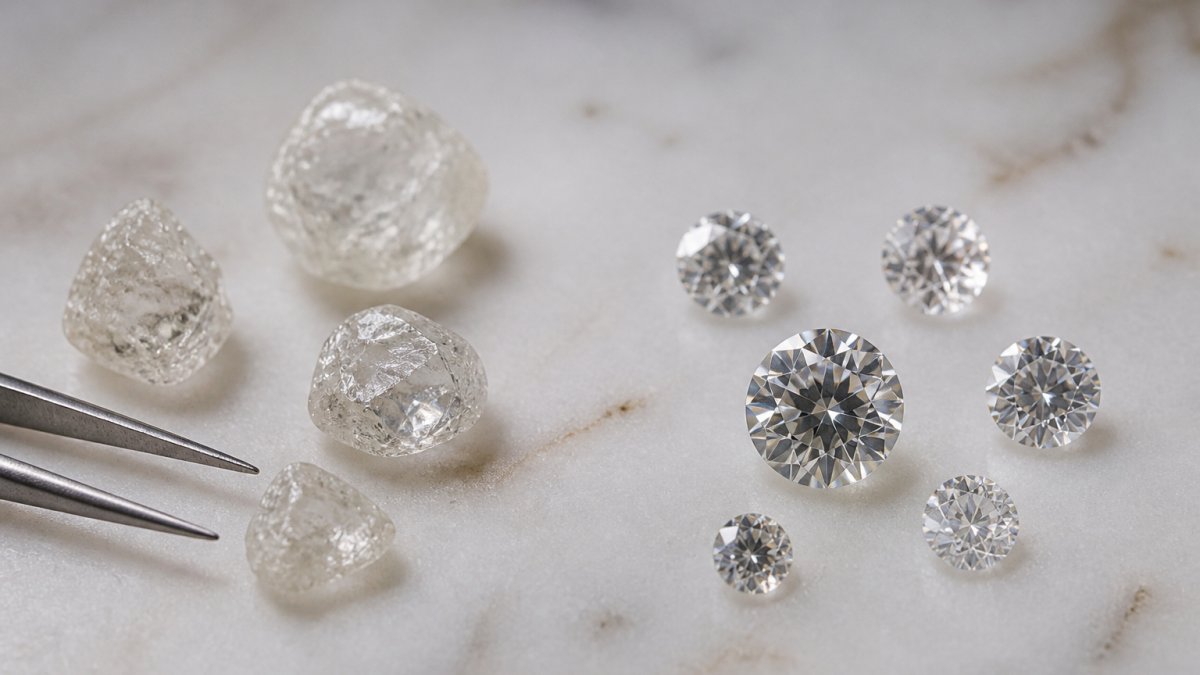
A mined diamond forms deep beneath the Earth’s surface over billions of years. Carbon atoms are subjected to extreme heat and pressure, creating the crystal structure that makes a diamond a diamond. These stones are then brought to the surface through mining, cut, and polished before reaching a jeweler.
Lab-grown diamonds are created in controlled environments that replicate those extreme conditions. Instead of billions of years, the process takes weeks to a few months. A small seed diamond is placed in a chamber where carbon is deposited layer by layer, building a new diamond from scratch.
The end result is chemically and physically identical. Both are real diamonds. The only meaningful difference is how long nature (or technology) took to build them.
Lab-Grown Diamond Pros and Cons for Engagement Rings
Lab-grown diamonds offer clear advantages for certain buyers. They cost significantly less than mined diamonds of comparable quality. If you want a larger stone or higher clarity within your budget, lab-grown is the practical choice.
They’re also created without the mining process, which appeals to buyers concerned about environmental impact and labor practices. You know exactly where the diamond came from and how it was made.
The trade-off: lab-grown diamonds don’t hold resale value the way mined diamonds do. If you ever want to sell or trade your ring, expect to recover only a fraction of what you paid. Mined diamonds, by contrast, have established resale markets and perceived lasting value.
For everyday wear, lab-grown diamonds perform identically to mined ones. Both score 10 on the Mohs hardness scale. Both resist scratching and maintain their sparkle over decades of wear.
Lab-grown diamonds are cheaper upfront and ethically transparent, but they carry lower resale value. Mined diamonds cost more initially but hold perceived value over time.
Lab-Grown Diamond Price vs Natural Diamond Price
Price is often the primary driver of the lab-grown vs mined choice, but the comparison is more nuanced than a simple percentage discount. To make an informed decision, you need to understand how prices vary by quality grade and how the savings translate into real engagement-ring costs.
Price by Carat Weight and Quality
Pricing for diamonds varies significantly based on carat weight, color, and clarity grade. Lab-grown diamonds typically cost less than mined diamonds of comparable quality, with the price difference often widening at higher carat weights.
However, price alone doesn’t capture the full engagement-ring cost. A complete ring includes the center stone, the band metal (platinum, white gold, yellow gold, or rose gold), and any accent stones. A mined diamond center stone might represent 50-70% of the total ring cost, while a lab-grown center stone often represents only 30-40%, shifting budget allocation toward the setting.
How Buyers Typically Spend the Savings
Couples who choose lab-grown diamonds follow one of three spending patterns:
-
Larger stone, same budget. A $5,000 budget buys a 0.75-carat mined diamond (mid-range quality) or a 1.5-carat lab-grown diamond (comparable quality). This appeals to buyers prioritizing visual impact and carat weight.
-
Same carat weight, higher quality. A $5,000 budget buys a 1-carat mined diamond (lower color/clarity) or a 1-carat lab-grown diamond (higher color/clarity, often D-E color and VS1 clarity). This appeals to buyers who want a specific carat weight but prefer superior optical characteristics.
-
Invest in the setting. A $5,000 budget buys a 0.75-carat mined diamond with a basic band, or a 0.75-carat lab-grown diamond with a premium setting in platinum or a custom design. This appeals to buyers who value craftsmanship and the overall aesthetic of the finished ring.
Price Volatility and Market Factors
Mined diamond prices fluctuate based on global supply, demand, and commodity markets. Lab-grown diamond prices have declined steadily as production capacity has increased and technology has improved. Lab-grown diamond prices have declined steadily as production capacity has increased and technology has improved, while mined prices have remained relatively stable.
Lab-grown diamonds are also subject to less price variation between retailers. Mined diamonds, graded by the same standards, can vary significantly in price depending on the seller’s sourcing, certification, and markup. Always request a grading report and compare prices across multiple jewelers before committing.
The Hidden Cost: Resale and Trade-In Value
While lab-grown diamonds cost less upfront, they carry a significant long-term cost: resale value recovery is minimal. A mined diamond may resell for a percentage of its original purchase price, with the recovery rate depending on color, clarity, and current market conditions. A lab-grown diamond typically resells for a much smaller percentage of its original purchase price.
Some jewelers offer trade-in programs where you can exchange a lab-grown diamond toward a mined diamond purchase, but these programs typically apply a smaller percentage of the original purchase price as credit. Mined diamonds have established secondary markets through auction houses, online resale platforms, and jewelry retailers; lab-grown diamonds do not.
Lab-grown diamonds deliver 60-70% savings on the center stone, which most buyers redirect toward a larger stone, higher quality, or a premium setting. However, plan on keeping the ring long-term; resale recovery is minimal and unpredictable.
How to Tell Lab-Grown from Mined Diamonds
Visually, you cannot tell the difference. Lab-grown and mined diamonds look identical to the naked eye and under magnification. They sparkle the same way, refract light the same way, and display the same color and clarity characteristics.
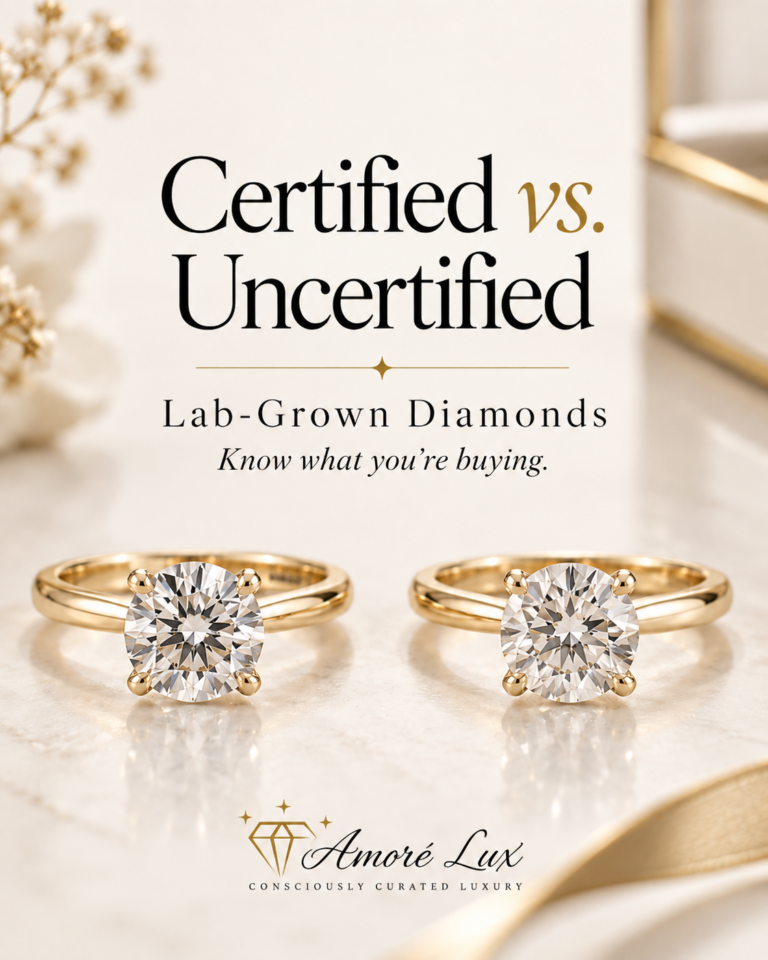
The only way to know for certain is certification. A certified gemologist uses specialized equipment to detect subtle differences in how the diamond was grown. Lab-grown diamonds carry a disclosure on their grading report stating they are laboratory-created.
When you buy any diamond, lab-grown or mined, demand a grading report from an independent lab. This report documents the diamond’s carat weight, color, clarity, and cut. For lab-grown stones, it will explicitly state “laboratory-created” or “lab-grown.”
Never rely on a seller’s word alone. Certification is your proof.
Do Lab-Grown Diamonds Hold Their Value Over Time
Resale value is where lab-grown and mined diamonds diverge most sharply. Understanding the realistic expectations, and the practical implications for insurance, appraisals, and replacement, is essential before you buy.
Resale Value: The Hard Numbers
Mined diamonds have centuries of trading history and established secondary markets. A mined diamond typically resells for a percentage of its original price through a jeweler, auction house, or online resale platform.
Lab-grown diamonds have no established resale market. Most jewelers do not accept lab-grown diamonds as trade-ins toward new purchases.
This gap reflects market perception, not physical difference. Buyers perceive mined diamonds as scarce and enduring; lab-grown diamonds as commodity products that depreciate immediately upon purchase.
Appraisals and Insurance
Appraisals are critical for both diamond types, but they are handled differently by insurers.
A mined diamond is typically appraised at or near its retail purchase price. If you paid for a mined diamond, an independent appraiser will value it at or near its retail purchase price for insurance purposes.
A lab-grown diamond is appraised at its current market value, which is significantly lower than the purchase price.
Always obtain a written appraisal from a certified gemologist (American Society of Appraisers member) regardless of which diamond type you choose. Do not rely on the jeweler’s estimate; independent appraisals are required by most insurance companies.
Replacement and Upgrade Costs
If your lab-grown diamond is damaged or you want to upgrade, replacement costs are straightforward: you pay current market price for a new lab-grown stone.
If your mined diamond is damaged, replacement cost is also current market price.
Long-Term Value Perception
The resale value gap reflects a fundamental difference in how these diamonds are perceived. Mined diamonds are marketed as timeless, scarce, and suitable for heirlooms. Lab-grown diamonds are marketed as affordable, ethical, and practical.
If you plan to pass the ring to a child or grandchild, a mined diamond carries cultural and financial value.
If you plan to wear the ring for decades and never sell it, resale value is irrelevant. The diamond will perform identically whether it is lab-grown or mined.
Do not buy a lab-grown diamond expecting it to hold value or serve as an investment. Plan on keeping it permanently. If you anticipate selling, upgrading, or passing the ring to the next generation, a mined diamond is the more practical choice despite the higher upfront cost.
Which Diamond Type Is Right for Your Engagement Ring
The choice comes down to your priorities. If budget is your primary concern and you want the largest, most beautiful stone possible, lab-grown wins. You get more carat weight and higher clarity for less money.
If you value perceived long-term value, resale potential, and the story of a natural diamond formed over billions of years, mined is the traditional choice. You’ll pay more upfront, but the diamond carries established market value.
Consider these questions: Will you wear this ring every day for decades? Are you comfortable with zero resale value? Do environmental and labor practices matter more to you than cost? Do you want the largest possible stone, or the highest quality within a set budget?
At Amoré Lux, we believe the best diamond is the one that aligns with your values and your life. Whether you choose lab-grown or mined, what matters most is that your ring feels authentic to who you are. Both options are real diamonds that will sparkle beautifully for a lifetime.
Frequently Asked Questions
Should I buy a lab-grown or mined diamond for an engagement ring?
The choice depends on your priorities. Lab-grown diamonds typically cost less than mined diamonds of comparable quality and have identical chemical and optical properties, making them ideal if budget and environmental impact matter to you. Mined diamonds appeal to buyers prioritizing long-term resale value and traditional provenance. Both are equally durable for everyday wear. Consider your values, budget, and whether resale matters to you when deciding between lab-grown vs mined diamonds.
Can a jeweler tell if a diamond is lab-grown or mined?
Yes, but only with specialized equipment. Jewelers use advanced tools like spectroscopy and luminescence testing to distinguish lab-grown from mined diamonds. A gemological certificate from the Gemological Institute of America (GIA) or similar body will explicitly state the diamond’s origin. However, to the naked eye and under standard magnification, lab-grown and mined diamonds are visually identical, which is why certification is essential for verification.
Do lab-grown diamonds hold their value?
Lab-grown diamonds typically do not hold resale value as well as mined diamonds. Because lab-grown diamonds are newer to the market and production costs continue to decline, their secondary market value is limited. If you plan to keep your engagement ring indefinitely, this matters less. If potential resale or trade-in value is important to you, mined diamonds historically retain value better, though neither type should be viewed as a financial investment.
Are lab-grown and mined diamonds chemically the same?
Yes. Lab-grown and mined diamonds have identical chemical composition (pure carbon arranged in a crystal lattice), the same physical hardness (10 on the Mohs scale), and the same optical properties like refractive index and sparkle. The only difference is origin: mined diamonds formed deep in the Earth over billions of years, while lab-grown diamonds are created in controlled laboratory conditions over weeks or months. This identical composition is why lab-grown diamonds are certified as real diamonds.
Finding the right engagement ring means finding a diamond that matches both your budget and your values. At Amoré Lux, we work with you to understand the trade-offs between lab-grown vs mined diamonds and help you choose the stone that feels right. Our thoughtfully crafted settings showcase either type of diamond beautifully, designed to empower you and celebrate the moment that matters most. Explore our collection and discover the piece that tells your story.