Matching Wedding Bands for Him and Her: A Complete Guide
Table of Contents
- Why Matching Wedding Bands Matter for Couples
- His and Hers Wedding Band Sets: Finding Your Style
- Metals That Work for Matching Wedding Rings for Couples
- Custom Matching Wedding Bands: Personalization and Coordination
- Sizing, Comfort, and Daily Wear Durability
- Ethical Sourcing and Responsible Materials
- Making Your Final Decision
- Frequently Asked Questions
Last Updated: October 12, 2026
Why Matching Wedding Bands Matter for Couples
Matching wedding bands for him and her represent far more than coordinated jewelry. They’re a visible commitment to partnership, a daily reminder that two people chose each other. When you wear matching bands, you’re making a statement that’s both personal and public.
The beauty of matching wedding bands lies in their flexibility. You don’t need identical rings to achieve that sense of unity. Many couples find that complementary designs, where bands coordinate without being exact replicas, feel more authentic to their individual styles.
The best matching wedding bands are the ones that feel true to both partners’ personalities while still creating visual harmony. This isn’t about compromise, it’s about intentional design that honors both people in the relationship.
The emotional weight of matching bands shouldn’t be underestimated. When you glance down and see your ring, then notice your partner’s complementary band, there’s a quiet reassurance. You’re not just wearing jewelry. You’re wearing a symbol of your commitment, refined through thoughtful choice and personal expression.
His and Hers Wedding Band Sets: Finding Your Style
Plain and Classic Band Designs
A plain wedding band remains the most versatile choice for couples seeking timeless elegance. These designs work across every metal type, every budget range, and every lifestyle.
Plain bands offer several advantages for daily wear. They don’t catch on fabric or hair. They’re easier to clean and maintain. They photograph beautifully in any light.
The real sophistication in plain bands comes from their finish. A high-polish finish reflects light and creates a mirror-like surface. A matte finish absorbs light and feels more contemporary.
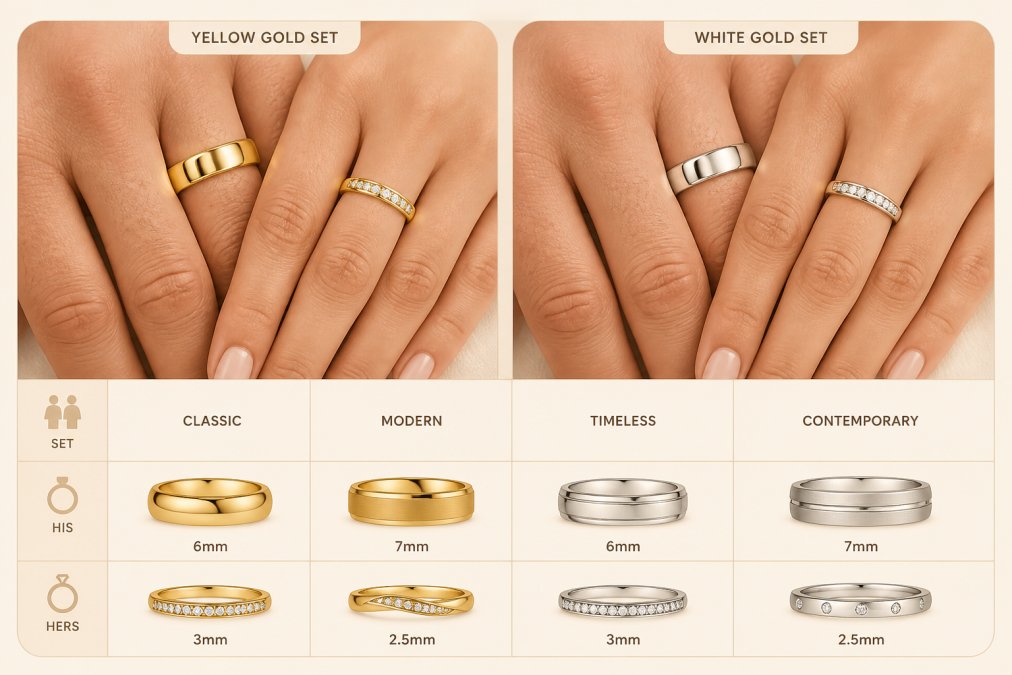
Width is another variable that lets plain bands feel coordinated yet distinct. Classic widths range from 2mm to 6mm. A common pairing is a 4mm band for one partner and a 3mm or 5mm for the other.
Diamond and Gemstone Settings
Diamonds and colored gemstones add dimension to matching wedding bands. The key is deciding whether both bands will feature stones, or if one partner’s band will while the other remains plain.
Many couples choose a single row of diamonds or gemstones set into the band itself. This creates continuous sparkle around the entire circumference. Other couples prefer a three-stone setting or a bezel-set center stone. These approaches draw the eye to specific points on the band, creating visual interest without overwhelming the design.
Colored gemstones offer personality that diamonds alone cannot match. Sapphires, emeralds, and rubies coordinate beautifully across matching bands.
Lab-grown diamonds have transformed the stone-setting conversation. They’re chemically identical to mined diamonds, they’re more affordable, and they carry a transparent supply chain. For couples who value ethical sourcing and want to know exactly where their stones came from, lab-grown options align with those priorities.
Metals That Work for Matching Wedding Rings for Couples
Gold Options: Yellow, White, and Rose Gold
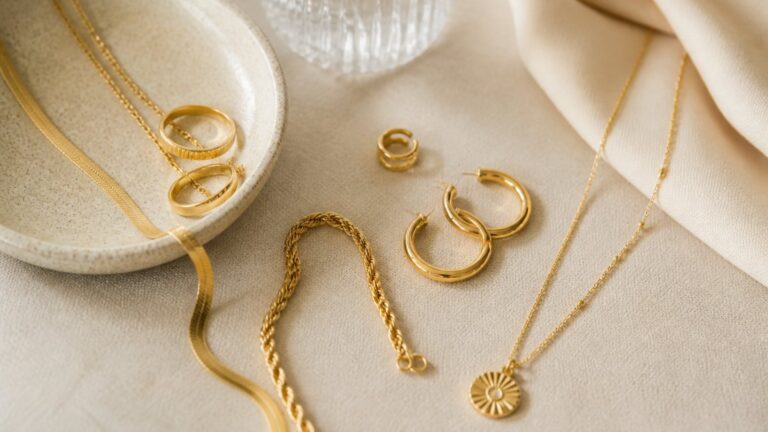
Gold remains the most popular choice for matching wedding bands. It’s warm, it’s durable in the right karat weight, and it works across every aesthetic. The decision isn’t whether to choose gold, but which type.
Yellow gold carries traditional warmth. It’s the color most people envision when they think of wedding bands. 14k yellow gold is the industry standard, it’s 58% pure gold mixed with alloy metals that increase durability. 18k yellow gold (75% pure) is softer and more prone to scratching with daily wear, but it’s richer in color and appeals to people who want maximum gold content.
White gold emerged as a popular alternative in the late 20th century. It’s yellow gold mixed with white metals like palladium or nickel. The result is a silvery appearance that’s become iconic for engagement rings and wedding bands.
Rose gold has surged in popularity over the past decade. It’s yellow gold alloyed with copper, creating a warm pink tone. Rose gold feels contemporary without being trendy. It photographs beautifully and pairs well with both warm and cool skin tones.
Many couples choose different gold types for their matching bands. One partner might wear yellow gold while the other chooses white gold or rose gold. The coordination comes from the band width, finish, or stone choice rather than the metal itself.
Platinum and Hypoallergenic Choices
Platinum is the premium choice for matching wedding bands. It’s naturally white, it never requires plating, and it’s denser and more durable than gold. Platinum also holds gemstones more securely than gold due to its strength. The trade-off is cost, platinum is significantly more expensive than gold.
For couples with metal sensitivities, platinum and palladium are hypoallergenic options. Nickel, which is common in white gold, triggers allergic reactions in some people. Pure platinum and palladium-based alloys avoid this issue entirely. If either partner has experienced jewelry allergies in the past, platinum or palladium-based white gold becomes the logical choice.
Titanium and tungsten are emerging alternatives for couples seeking durability and affordability. Both metals are scratch-resistant and maintain their finish without maintenance. They’re lighter than gold or platinum, which some people prefer and others find unusual. These metals work particularly well for people with active lifestyles or jobs where traditional precious metals might get damaged.
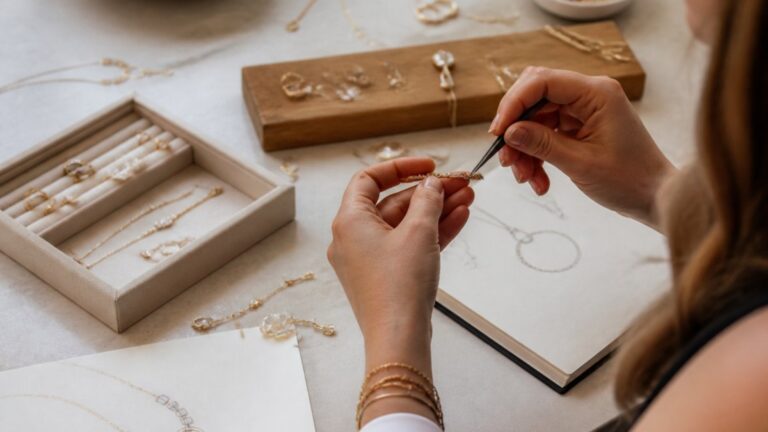
Custom Matching Wedding Bands: Personalization and Coordination
Engraving and Meaningful Inscriptions
Engraving transforms a band from beautiful jewelry into a personal artifact. The most common engravings are initials, wedding dates, or brief phrases. The key is keeping the message concise, engraving space is limited, and legibility matters.
Wedding dates are the most popular choice. A simple format like “10.12.26” or “October 12, 2026” fits comfortably inside most bands. Some couples engrave the date on both bands. Others engrave the date on one band and initials on the other, creating a complementary pair.
Phrases work when they’re short. “Forever,” “Always,” “Our Love,” or a partner’s initials all work well. Longer messages become difficult to read and can feel cluttered.
Engraving placement matters. Inside the band is traditional and keeps the message private. Some couples choose to engrave the outside of the band, making the message visible to others. Outside engravings require slightly larger text to remain legible, so message length becomes even more important.
Coordinating Without Identical Designs
The assumption that matching bands must be identical is worth challenging. Some of the most striking coordinated pairs feature intentional differences.
One approach is to use the same metal and width but vary the finish. Imagine one band with a high-polish surface and its partner with a matte finish. They coordinate visually, but each maintains distinct character. Another approach is to keep the finish consistent but vary the width.
Stone settings offer another avenue for coordination. Both bands might feature diamonds, but one could have a three-stone design while the other features a single center stone. Or one band might be set with diamonds while the other remains plain, with the plain band echoing the metal and width of the stone-set partner.
Texture is an underutilized coordination tool. One band might feature hammered texture while its partner remains smooth. Or one might have subtle milgrain detailing while the other is clean and modern. These textural differences create visual interest without requiring the bands to look completely different.
Sizing, Comfort, and Daily Wear Durability
Getting the sizing right is non-negotiable. A band that’s too tight will be uncomfortable and difficult to remove. A band that’s too loose risks falling off.
The best approach is to have both partners sized by a jeweler in person. This eliminates guesswork and ensures accuracy. If in-person sizing isn’t possible, ring sizers shipped through the mail are reliable alternatives.
Comfort-fit bands have a curved interior that sits more comfortably against the finger. Traditional flat-interior bands can feel slightly less comfortable during the first week of wear, but most people adjust quickly.
Width affects comfort significantly. Thinner bands (2-3mm) feel lighter and less noticeable. Wider bands (5-6mm) make a bolder statement but require a slight adjustment period. Most people find their comfort zone between 3.5mm and 4.5mm.
Daily wear durability depends on metal choice and care habits. Gold bands are remarkably durable in 14k or higher. Platinum is even more durable. Both metals develop a patina over time, small scratches that create a lived-in appearance.
Ethical Sourcing and Responsible Materials
The sourcing story behind your bands matters. Lab-grown diamonds are chemically identical to mined diamonds but carry a transparent supply chain. You know exactly where the diamond came from and how it was created.
Recycled gold and platinum are increasingly available. Using recycled precious metals reduces the environmental impact of mining and honors the principle of circular economy. Recycled metals are indistinguishable from newly mined metals, the quality and durability are identical. The only difference is the sourcing story.
Some couples explore alternative materials like Koa wood, which is sustainably harvested and creates unique, warm-toned bands. Others choose tungsten or titanium specifically because these metals don’t require mining precious resources. These choices reflect personal values and aesthetic preferences in equal measure.
Amoré Lux prioritizes transparency in sourcing. This commitment to supply chain clarity means you’re not just buying beautiful jewelry, you’re buying with confidence that your purchase aligns with your values.
Making Your Final Decision
The best matching wedding bands are the ones that feel right when you wear them. This means considering metal choice, design style, stone preferences, and personalization options together rather than in isolation.
Start by identifying what matters most to both partners. Is durability the priority? Aesthetic coordination? Ethical sourcing? Personal expression? Budget? Once you’ve identified your top priorities, the decision path becomes clearer.
Visit a jeweler in person if possible. Try on different metals, widths, and finishes. Notice how they feel on your finger and how they look against your skin tone.
Consider your lifestyle. If you work with your hands or engage in active pursuits, durability and low-maintenance finishes become more important.
The price conversation deserves honesty. Quality matching wedding bands represent a meaningful investment, but you don’t need to overspend to get excellent rings. Set a budget that feels comfortable, then prioritize features within that range.
Selecting matching wedding bands for him and her is an opportunity to create something beautiful that reflects your partnership. Our curated collection features ethically sourced metals, lab-grown diamonds, and designs that celebrate both unity and individual expression.
Frequently Asked Questions
Should wedding bands for a couple match exactly, or can they be different?
Matching wedding bands don’t need to be identical to feel coordinated. Many couples choose bands in the same metal but different widths, finishes, or stone settings. Others mix metals entirely, pairing white gold with rose gold, for example. The key is selecting designs that complement each other visually and reflect both partners’ personal styles. What matters most is that the bands feel intentional as a pair, not that they’re exact duplicates.
What metal is best for matching wedding bands worn every day?
Platinum and 14k gold are the most durable metals for daily wear matching wedding bands. Platinum is naturally hypoallergenic and extremely resistant to scratching, making it ideal for active lifestyles. 14k gold offers a good balance of durability and workability for intricate designs. White gold, rose gold, and yellow gold all perform well for everyday wear when properly maintained. Choose based on your skin tone, personal preference, and lifestyle, all quality metals will last a lifetime with proper care.
How can we personalize our matching wedding bands beyond basic engraving?
Beyond traditional engraving with initials or dates, custom matching wedding bands can feature unique touches like mixed metals, varying band widths, subtle stone accents, or handcrafted details that reflect your story. Some couples choose complementary designs where each band has its own character but they work as a visual pair. Responsibly sourced materials and lab-grown diamonds also add personal meaning. Work with a jeweler who understands your vision to create bands that feel authentically yours while maintaining the coordinated look.
Will lab-grown diamonds in matching wedding bands hold up as well as mined diamonds for everyday wear?
Lab-grown diamonds are chemically and physically identical to mined diamonds, so they perform equally well for everyday wear. Both score 10 on the Mohs hardness scale and resist scratching and damage at the same rate. The difference lies in origin and cost, not durability. Many couples choose lab-grown diamonds for matching wedding bands because they offer the same lifetime performance while aligning with ethical and environmental values. Proper care and maintenance, avoiding harsh chemicals and regular professional cleaning, will keep either type brilliant for decades.