Best Jewelry for Everyday Work Wear: A 2026 Guide
Table of Contents
- Choosing the Best Jewelry for Everyday Work Wear
- Office Jewelry for Women: Matching Pieces to Your Dress Code
- Comfortable Jewelry for Work: What to Look For
- Minimalist Jewelry for Work: Studs, Delicate Chains, and Thin Rings
- Metals, Sensitive Skin, and Long-Term Durability
- How to Build a Work Jewelry Collection That Lasts
- Caring for Your Everyday Work Jewelry
- Conclusion
- Frequently Asked Questions
Last Updated: October 12, 2026
Choosing the Best Jewelry for Everyday Work Wear
The best jewelry for everyday work wear is lightweight, secure, and quiet enough to sit through a nine-hour day and a client lunch without a second thought.

A common mistake is buying statement pieces first and basics last. It should be the reverse.
The U.S. Bureau of Labor Statistics American Time Use Survey tracks how much of the day adults spend working and commuting, which is a useful reminder of how much wear your jewelry actually absorbs.
Build your work rotation around three or four pieces you never take off, not a drawer of occasion jewelry you wear twice a year.
Office Jewelry for Women: Matching Pieces to Your Dress Code
Office jewelry for women should match the formality of the room, not the season’s trend. Dress codes are not decoration rules, but they are reliable signals about how much visible jewelry reads as appropriate. The pieces barely change; the volume does.
| Dress Code | Earrings | Necklace | Bracelet | Rings |
|---|---|---|---|---|
| Business formal | Small studs or short drops | Single pendant, 16-18 in | One slim cuff or none | One ring per hand |
| Business casual | Studs, huggies, small hoops | Delicate chain, layered fine | Stacked bracelets, 2-3 | Stackable thin rings |
| Client-facing | Polished studs or huggies | Short pendant above the neckline | One slim bracelet or none | One to two thin rings |
| Hands-on or safety-sensitive | Huggie hoops or none | Tucked chain or none | None | Plain band only |
Business Formal vs. Business Casual
Business formal rewards restraint. Small stud earrings, a single pendant necklace, and one ring read as polished rather than plain. Keep total visible metal to roughly three touchpoints: ears, neck, and one hand.
Business casual is where you can loosen the rules. Huggie hoops, layered necklaces, and stacked bracelets all work when each piece stays thin and refined. A useful test: if you can hear your jewelry when you gesture, it is too much for a shared office.
Client-Facing and Presentation Roles
If you are on camera, at a front desk, or in sales meetings, jewelry reads as part of your professional presentation. Choose pieces that photograph cleanly: small polished studs, a short pendant that sits above a neckline, and a single slim bracelet. Avoid large dangles that move on camera and oversized cuffs that clack against a desk or conference table.
Hands-On and Safety-Sensitive Roles
Roles involving machinery, patient care, food handling, or lab work call for a different standard. The Occupational Safety and Health Administration guidance on workplace hazards is clear that loose items and jewelry can create catching and entanglement risks around moving equipment.
For those roles, choose huggie hoops over drops, tuck a short chain under a collar, and skip bracelets entirely. A plain band is safer than a raised setting.
Matching Jewelry to the Tasks You Actually Do
Dress code sets the ceiling; your daily tasks set the floor. Match the piece to the job:
- Typing all day: thin bands under 2 mm and a bracelet that sits above the wrist bone so it does not drag on the keyboard.
- Headsets and phones: skip large hoops and long drops that tangle in cords or press against the ear cup; studs and huggies stay clear.
- Gloves and PPE: smooth bands, huggies, and tucked chains only. Anything with prongs, dangles, or a loose clasp can catch on the glove edge.
- Patient care or childcare: avoid dangles a person can grab; choose locking backs so a piece cannot be pulled free.
- Food handling and labs: many workplaces require bare hands and wrists; a plain band and small studs are the practical maximum.
Dangling earrings and loose bracelets near rotating equipment or moving patients are a genuine catching hazard. Swap to huggies and remove bracelets before your shift, not after an incident.
A Quick Fit Check Before You Leave
Run through this in ten seconds before you walk out the door: can you type without your bracelet dragging? Can you put on a headset without your earring catching? Can you pull on a glove without a prong snagging? If the answer is no to any of these, swap the piece. The right work jewelry is the piece you forget you are wearing by 10 a.m.
Comfortable Jewelry for Work: What to Look For
Comfortable jewelry for work comes down to three things: weight, closure, and finish. A piece that meets all three disappears on your body by mid-morning, which is exactly what you want.
- Weight: under a few grams per earring; heavy drops pull on the lobe by afternoon
- Closure: screw-backs or locking huggies for earrings, lobster clasps for necklaces
- Finish: smooth edges on rings and cuffs so nothing catches on sleeves or keyboards
- Length: pendants that sit above a neckline so they do not swing into your desk
- Width: bands slim enough to type and grip without pressure points
If you are coming from fashion jewelry, expect fine pieces to feel lighter, not heavier. That is the point.
Minimalist Jewelry for Work: Studs, Delicate Chains, and Thin Rings
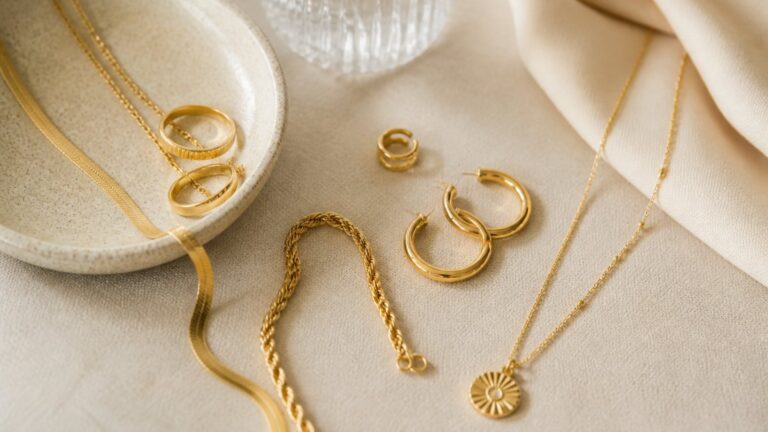
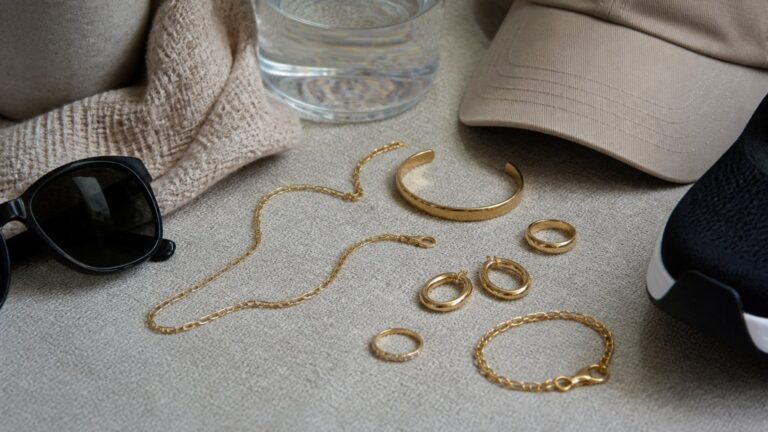
Minimalist jewelry for work is the safest default because it layers without competing. The category covers four workhorses: stud earrings, huggie hoops, delicate chain and pendant necklaces, and thin stackable rings.
Studs and huggies stay put through meetings and commutes. A delicate necklace in a Figaro or fine cable chain sits flat under a collar. Thin rings stack on one finger or spread across several without bulk.
What most guides miss is that minimalist does not mean flimsy.
A Minimalist Set That Works for Almost Anyone
If you are starting from zero, this is the smallest set that covers a full work week:
- One pair of small studs (3-5 mm) for the most formal days
- One pair of huggies for business casual and hands-on days
- One delicate chain, 16-18 in, with a small pendant
- One thin band, 1.5-2 mm, that stacks or wears alone
- One slim bracelet or cuff for days you want a little more
That is five pieces. They mix into dozens of combinations, and every one of them disappears on the body by mid-morning.
Inclusive Styling: Piercings, Sensory Needs, and Adaptive Closures
Most work jewelry advice assumes two lobe piercings and no sensory sensitivities. That leaves out a lot of people. A few practical adjustments make minimalist jewelry work for more bodies and more routines:
- Multiple piercings: a curated ear of small studs and huggies in a single metal reads as one polished unit rather than several competing pieces. Keep every piece in the same finish so the ear looks intentional.
- Single piercing or none: a delicate necklace and a thin ring carry the same minimalist effect without earrings. You do not need pierced ears to build a work rotation.
- Cartilage and helix piercings: flat-back labrets and small seamless hoops sit flush against the ear, so they clear headsets, hats, and helmet straps that a traditional butterfly back can catch on.
- Sensory sensitivity: smooth finishes, lightweight pieces under a few grams, and quiet clasps matter more than style. If a piece feels noticeable, it will distract you all day. Magnetic and screw-back closures are easier to fasten and unfasten for anyone with limited dexterity or long nails.
- Adaptive closures: lobster clasps with a larger tab, magnetic necklace clasps, and hinged huggies are easier to operate one-handed than a tiny spring ring. If you dress in a hurry or have limited hand strength, these are worth seeking out.
Buy your most-worn piece in the most durable metal you can justify. Cost per wear drops fast when a necklace survives daily showers, gym sessions, and endless laptop hours.
The goal is not a uniform look. It is a small set of pieces that fit your ears, your hands, and your daily routine, so you stop thinking about your jewelry and get on with your work.
Metals, Sensitive Skin, and Long-Term Durability
Metal choice matters more than design for anyone with sensitive skin. Sterling silver, 14-karat and 18-karat gold, gold vermeil, rose gold vermeil, and black ruthenium vermeil all behave differently against skin and over time.
Nickel is the most common trigger for contact dermatitis, and the U.S. Food and Drug Administration overview of nickel in jewelry notes that even small exposures can cause reactions in sensitized people.
If your skin reacts easily, favor high-karat gold, sterling silver, or vermeil with a thick gold layer over a sterling base.
Durability follows the same logic: solid metals hold shape, thick vermeil resists fading, and secure settings keep stones in place.
How to Build a Work Jewelry Collection That Lasts
A work jewelry collection should be built in layers, not bought all at once. Start with the pieces you will wear most, then add as gaps appear in your rotation.
The Capsule Approach and Cost Per Wear
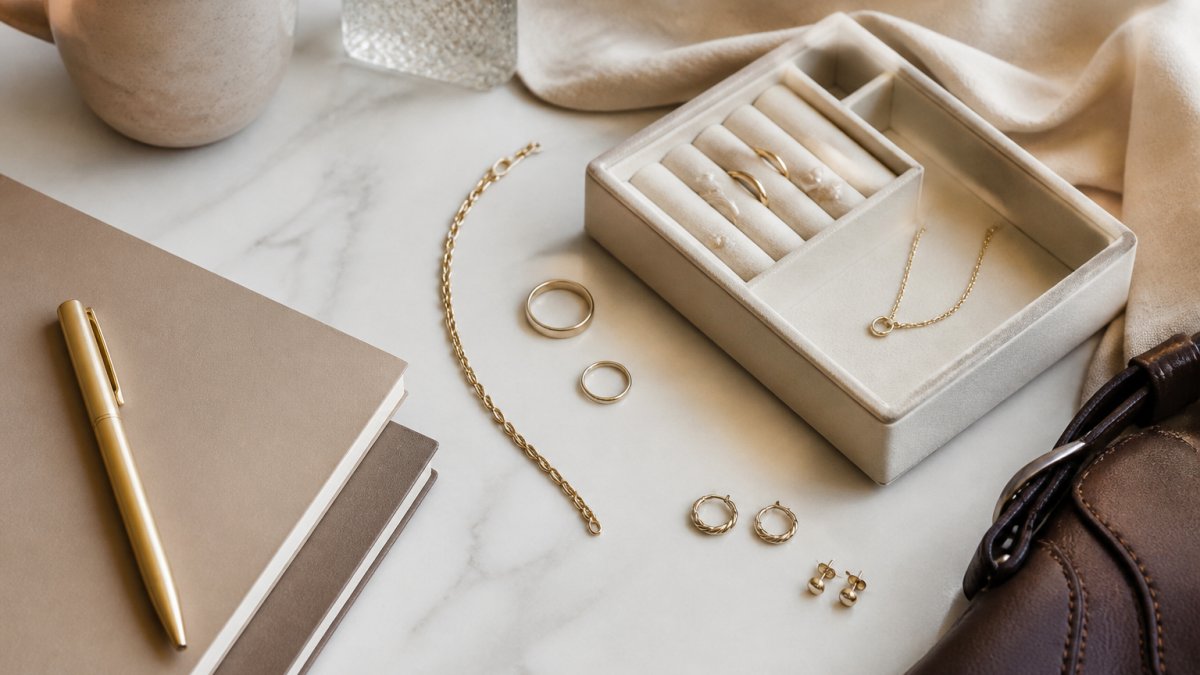
Think of your work jewelry as a small capsule: a few versatile pieces that mix and match across every professional outfit. A practical starting set looks like this:
- One pair of small studs or huggies for daily wear
- One delicate chain or pendant necklace
- One bracelet or slim cuff for business casual days
- One or two thin rings, stackable if you prefer
- One slightly dressier pair for special meetings
Cost per wear is the honest way to judge value. A piece worn four days a week for a year costs a fraction per wear of an occasion piece worn twice. That math favors quality over quantity every time.
We recommend buying the daily pieces first and adding the dressier pair last.
Anyone building a first professional wardrobe, or replacing a drawer of tarnished fashion jewelry with a small set of pieces that actually get worn.
Caring for Your Everyday Work Jewelry
Everyday work jewelry needs a two-minute routine, not a specialist kit.
Remove jewelry before swimming, cleaning with harsh chemicals, or heavy exercise. Check earring backs and clasps monthly, since a loose closure is the most common cause of a lost earring.
Pieces worn daily will eventually need a professional check, and that is normal, not a sign of poor quality.
Conclusion
The hardest part of building a work jewelry wardrobe is resisting the urge to buy everything at once. Start with the pieces you will wear four or five days a week, choose metals that suit your skin, and let the collection grow around your actual routine. At Amoré Lux, our pieces are designed for exactly that kind of daily life: thoughtfully crafted to reflect inner strength, made with intentional craftsmanship, and created to elevate everyday style rather than sit in a box.
Frequently Asked Questions
What jewelry is best for everyday work wear?
The best jewelry for everyday work wear balances polish and practicality. Stud earrings, delicate pendant necklaces, thin stackable rings, and simple bracelets in 14-karat gold, gold vermeil, or sterling silver work across most dress codes. Choose pieces that stay secure during typing, lifting, or meetings. A small capsule of versatile pieces you can mix and match will cover more outfits than a large collection of statement-only items.
How do I choose comfortable jewelry for a full workday?
Comfort comes down to weight, closure type, and fit. Look for lightweight studs or huggie hoops instead of heavy drop earrings, and choose necklaces with secure clasps that sit above your keyboard. Rings should slide on without pinching and come off easily at the end of the day. If you wear a headset or lanyard, skip long pendants that tangle. Hypoallergenic metals like sterling silver, 14-karat gold, and gold vermeil also reduce irritation during long wear.
Can you wear statement jewelry to work?
Yes, in most business casual and creative workplaces. The key is to limit statement pieces to one per outfit and keep the rest understated. A bold cuff bracelet or sculptural earrings can work if your other pieces stay minimal. In business formal or client-facing roles, keep statement pieces small and refined. Check your employee handbook or observe what senior colleagues wear before pushing the boundaries of your dress code.
How do I build a simple work jewelry collection?
Start with three or four versatile pieces: one pair of studs or huggie hoops, one delicate pendant or chain necklace, one thin ring or stackable band, and one simple bracelet. Choose a single metal tone so everything mixes and matches. Add a second necklace for layering or a slightly larger earring for special meetings. Track cost per wear over the first year; pieces you reach for daily justify a higher upfront cost than occasional-wear items.