Is Wholesale Luxury Jewelry for Small Boutiques Worth It?
Last Updated: November 8, 2026
Quick Summary
Wholesale luxury jewelry can be worth it for small boutiques if you plan the opening order around sell-through and cash flow rather than trend cycles. Budget separately from fashion jewelry, confirm minimums in writing, and keep a reserve for reorders so slow-selling fine pieces don’t drain your cash.
- Fine jewelry sells slower than fashion jewelry, so budget your open-to-buy separately for each category.
- Ask every supplier to state minimum order terms in writing, including per-style minimums and reorder thresholds.
- Split your open-to-buy roughly 60 percent to proven categories and 40 percent to new designs.
- Choose depth in a few designs rather than spreading an opening order across many shallow picks.
- Calculate landed cost, not just unit cost, before committing to a supplier’s wholesale prices.
Table of Contents
- Why Wholesale Luxury Jewelry for Small Boutiques Is a Different Purchase
- Fine Jewelry, Fashion Jewelry, and What Your Customers Expect
- Wholesale Jewelry Minimum Order Requirements: What Small Boutiques Actually Face
- Best Wholesale Jewelry Suppliers: A Side-by-Side Look for Small Boutiques
- Buying Wholesale Jewelry for Resale: Planning Your Opening Order
- Building a Jewelry Collection That Sells: Rings, Necklaces, Bracelets, and Earrings
- True Luxury Positioning: Materials, Certification, and Product Verification
- Private Label, Exclusivity, and Assortment Differentiation
- Requesting Amoré Lux Wholesale Terms for Your Boutique
- Frequently Asked Questions
Why Wholesale Luxury Jewelry for Small Boutiques Is a Different Purchase
Wholesale luxury jewelry for small boutiques is a buying decision measured in months of shelf life, not weeks of trend cycles. Boutique owners who treat a fine jewelry order like a fashion accessory restock often find the cash flow math punishes that mistake fast.
That’s the tension most buying guides skip. A boutique selling wholesale fashion jewelry can reorder every few weeks and swap out what doesn’t move.
Below, we’ll walk through the real minimums, supplier checks, and opening-order planning that separate boutiques who build a profitable fine jewelry case from those who end up with dead inventory.
Fine Jewelry, Fashion Jewelry, and What Your Customers Expect
The first split to make is between fine jewelry and fashion jewelry, because the two demand different suppliers, different margins, and different customer conversations.
Fine jewelry is made with precious metals such as sterling silver, 14k or 18k gold, and genuine gemstones or diamonds.
Fashion jewelry uses plated base metals, cubic zirconia, and often trend-driven designs. It moves faster, costs less, and lives or dies on how well it matches what’s on-trend this quarter.
Most small boutiques need both, but not in the same quantities. A common mistake is stocking fine jewelry with fashion-jewelry turnover expectations. Budget your open-to-buy separately for each category, and resist letting a fast-selling fashion line eat the budget your fine case needs.
Wholesale Jewelry Minimum Order Requirements: What Small Boutiques Actually Face
Wholesale jewelry minimum order requirements are the single most common reason small boutiques walk away from a luxury supplier. Many fine jewelry suppliers set a dollar minimum per opening order, and some pair it with per-style minimums.
The structure usually looks like one of these:
- A flat opening-order minimum, applied once before reorders can be smaller
- Per-style minimums, so you commit to a set number of units per design
- A mix of both, with lower thresholds for reorders than for the first order
Ask every supplier to state their minimums in writing before you fall in love with a collection. A supplier who won’t put terms in writing is telling you something.
Low Minimums, Opening Orders, and Flexible Payment Terms
Low minimums matter more to a small boutique than a slightly better unit price. A modest opening order lets you test a collection without betting the season on it. Flexible payment terms, such as net terms or split payments, ease the cash flow hit of stocking fine jewelry.
Watch out: a supplier who advertises unusually low minimums but won’t disclose per-style minimums is often hiding the real commitment in the fine print. Confirm the total dollar value you must spend to open the account, not just the headline number.
Best Wholesale Jewelry Suppliers: A Side-by-Side Look for Small Boutiques
No single supplier fits every boutique, so compare on the terms that affect your cash and your shelf: minimum order values, reorder thresholds, materials, shipping, and returns.
Use the framework below to score each supplier you consider. Fill in the terms you confirm in writing, and leave a field blank until the supplier states it in writing.
| Comparison factor | What to ask | Why it matters to a small boutique |
|---|---|---|
| Opening-order minimum | Total dollar value required to open the account | Sets the cash you must commit before you test the line |
| Per-style minimum | Units required per design | Forces depth in a few styles rather than breadth across many |
| Reorder threshold | Lower minimum for repeat orders | Determines how cheaply you can restock winners |
| Mixed-style purchasing | Whether you can combine styles to hit the minimum | Lets you spread risk across categories |
| Materials and purity | Metal stamps, stone origin, setting details | Separates fine jewelry from fashion merchandise |
| Certification | Grading reports for diamonds and gemstones | Backs the luxury claim at the counter |
| Shipping speed and cost | Lead time, transit insurance, who pays | Affects sell-through timing and landed cost |
| Returns and warranty | Return window, repair policy, restocking fees | Protects you against dead inventory |
| Payment terms | Net terms, split payments, deposits | Eases the cash flow hit of a fine order |
| Exclusivity | Territory protection, limited-run designs | Prevents selling the same assortment as nearby boutiques |
A few patterns are worth knowing. Marketplace models let you browse many brands in one place, but commercial terms vary by brand, so confirm minimums and returns brand by brand.
How to Verify a Supplier Before You Commit
Run every new supplier through this checklist before you place an opening order:
- Request the minimum order terms in writing, including per-style minimums and reorder thresholds
- Ask for material specifications: metal purity, stone origin, and setting details
- Confirm whether certification accompanies diamond or gemstone pieces
- Read the returns, repair, and warranty policy in full, including restocking fees
- Ask for references from other boutiques at a similar size
- Request high-resolution product images and exact dimensions
- Confirm shipping timelines, transit insurance, and who covers loss in transit
- Ask whether territory protection or limited-run designs are available
A supplier who answers all eight without hesitation is worth a conversation. One who dodges the certification or returns question is a risk you don’t need.
Buying Wholesale Jewelry for Resale: Planning Your Opening Order
Buying wholesale jewelry for resale works best when you plan the opening order around sell-through and cash flow, not around what looks good in a catalog.
Start with the math a small boutique actually runs.
Markup and gross margin. Wholesale jewelry is typically priced so a boutique can apply a keystone markup, roughly doubling the wholesale cost to set retail.
Cash flow and open-to-buy. Set your open-to-buy budget for the season, then split it deliberately: roughly 60 percent to proven categories and 40 percent to new designs, keeping a reserve for reorders.
Inventory risk. Fine jewelry sells slower than fashion jewelry, so the cost of a wrong pick is higher.
A practical approach to the opening order:
- Set your total open-to-buy budget for the season
- Split it roughly 60/40 between proven categories and new designs
- Choose a small number of styles per category rather than many shallow picks
- Keep a reserve for reorders on the pieces that move first
- Track sell-through weekly and reorder before you run dry on winners
- Review markup and gross margin per category after the first sell-through cycle
The mistake we see most is spreading an opening order across too many styles and spending the entire budget on the first order.
Building a Jewelry Collection That Sells: Rings, Necklaces, Bracelets, and Earrings
A balanced jewelry collection covers rings, necklaces, bracelets, and earrings, but not in equal depth. Rings and necklaces tend to carry the highest ticket and the strongest emotional pull, so they deserve the most space and the most careful selection.
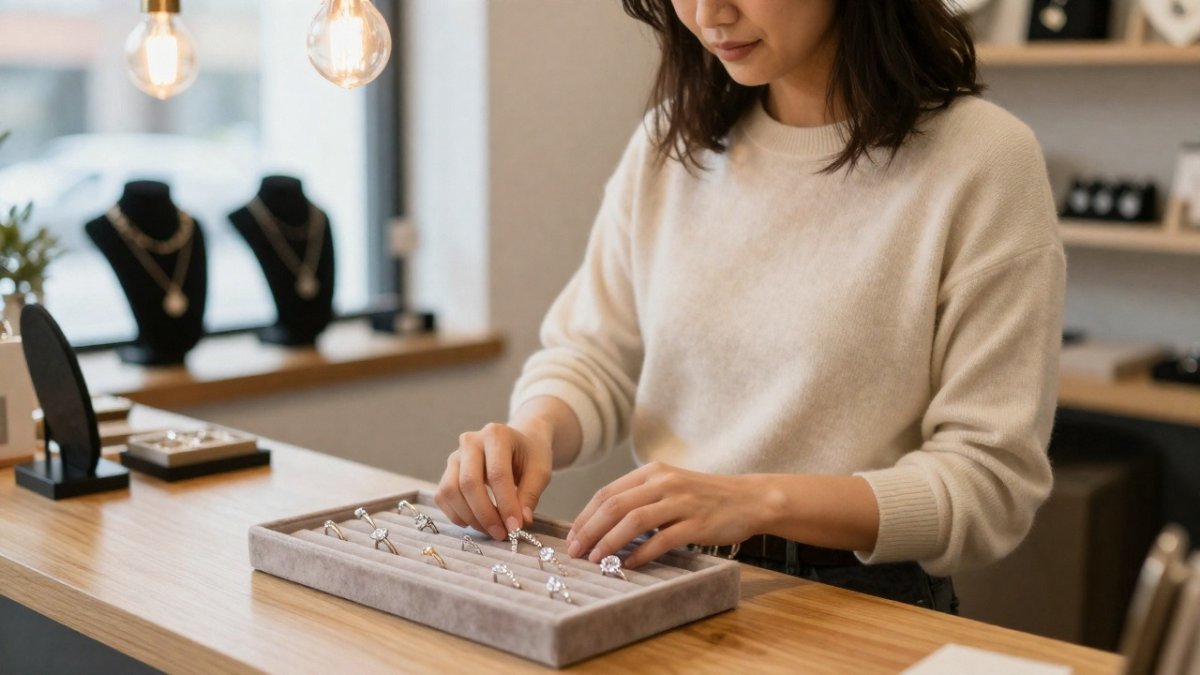
For rings, stock a mix of everyday bands and statement pieces. To see the ring styles and price points that anchor a fine assortment, explore our lab-grown diamond engagement rings.
Anklets and accessories can add a seasonal lift, but keep them a small share of the fine case. The core four categories should do the heavy lifting.
True Luxury Positioning: Materials, Certification, and Product Verification
True luxury positioning rests on verifiable materials and certification, not a higher price tag. A boutique that can show a customer exactly what a piece is made of, backed by documentation, earns trust a discount can’t buy.
Ask your supplier for metal purity stamps, stone specifications, and any lab certification that accompanies diamond pieces. Seeing a specific high-carat piece, like this 14k rose gold lab-grown diamond 4 ct tw fashion band, lets you verify material quality and craftsmanship claims before you commit to a line.
Position luxury around what the customer can confirm. That’s the difference between a boutique selling fine jewelry and one selling hope.
Private Label, Exclusivity, and Assortment Differentiation
Private label and exclusivity are how a small boutique competes with the big names without matching their ad budgets. If every boutique on your street stocks the same catalog, you’re competing on price. A supplier willing to offer exclusive or limited-run designs gives you something a chain can’t replicate.
Ask potential partners three questions:
- Can we get exclusive designs or a limited-run style for our store?
- Is there territory protection so nearby boutiques don’t carry the same pieces?
- Can we add our own branding or packaging to select items?
A distinctive statement piece illustrates the point. A 14k rose gold lab-grown diamond round and tapered 7 ct tw fashion band is the kind of design that signals a curated case rather than a catalog dump. Stock a handful of pieces competitors won’t have, and let those anchor your luxury story.
Requesting Amoré Lux Wholesale Terms for Your Boutique
The right wholesale partner makes the difference between a fine jewelry case that earns its space and one that drains your budget.
Amoré Lux combines design expertise with intentional craftsmanship to create pieces designed to feel personal.
For current wholesale information, visit the Amoré Lux website or contact the team directly.
The hardest part of stocking fine jewelry isn’t finding a supplier. It’s finding one whose terms, materials, and exclusivity actually fit a small boutique’s economics. Amoré Lux builds lab-grown diamond fine jewelry with intentional design, works directly with boutique owners on assortment, and offers pieces made to carry a real luxury story. Get started with Amoré Lux and build a fine jewelry case your customers can’t find anywhere else.
Frequently Asked Questions
How can a small boutique find wholesale luxury jewelry suppliers?
Start with suppliers whose terms you can verify in writing: order minimums, material specifications, return windows, and shipping timelines. Marketplaces let you compare several brands at once, while single-brand suppliers give you deeper information about materials and craftsmanship. Ask each supplier for a line sheet and a sample order before committing to a full opening order. Require documentation for any precious-metal or gemstone claims, and confirm the return policy in writing so a slow-selling style does not become dead inventory.
Do wholesale jewelry suppliers have minimum order requirements?
Most do, though the structure varies. Some set a dollar minimum per order, others require a certain number of units per style, and some ask for a larger opening order before they extend net payment terms. Wholesale jewelry minimum order requirements matter most for small boutiques because they decide how much capital sits in inventory before a single piece sells. Ask whether the minimum applies per order or per year, and whether reorders carry a lower threshold than the opening order. Get the answer in writing before you plan your buy.
What should a boutique compare when choosing a jewelry wholesaler?
Compare five things side by side: minimum order requirements, material specifications, return and warranty terms, shipping speed, and whether the supplier offers exclusivity or private label. Material claims deserve the closest look. Sterling silver should be marked 925, gold should carry a karat stamp, and gemstone or diamond claims should come with certification. A supplier with slightly higher prices but clear specifications and a real return window usually costs less over a year than one that ships unverifiable product you cannot sell at a luxury price.
How do I evaluate jewelry quality before buying wholesale?
Order samples first. Check the clasp and setting construction, confirm the metal stamp, and wear a piece for a week to see how the finish holds up. For sterling silver, look for a 925 mark; for gold, a karat stamp such as 14K. Ask whether stones are natural, lab-grown, or simulated, and request certification for anything sold as a diamond or precious gemstone. Also test the supplier’s responsiveness before you order: how quickly they answer a specification question tells you how they will handle a problem after the sale.